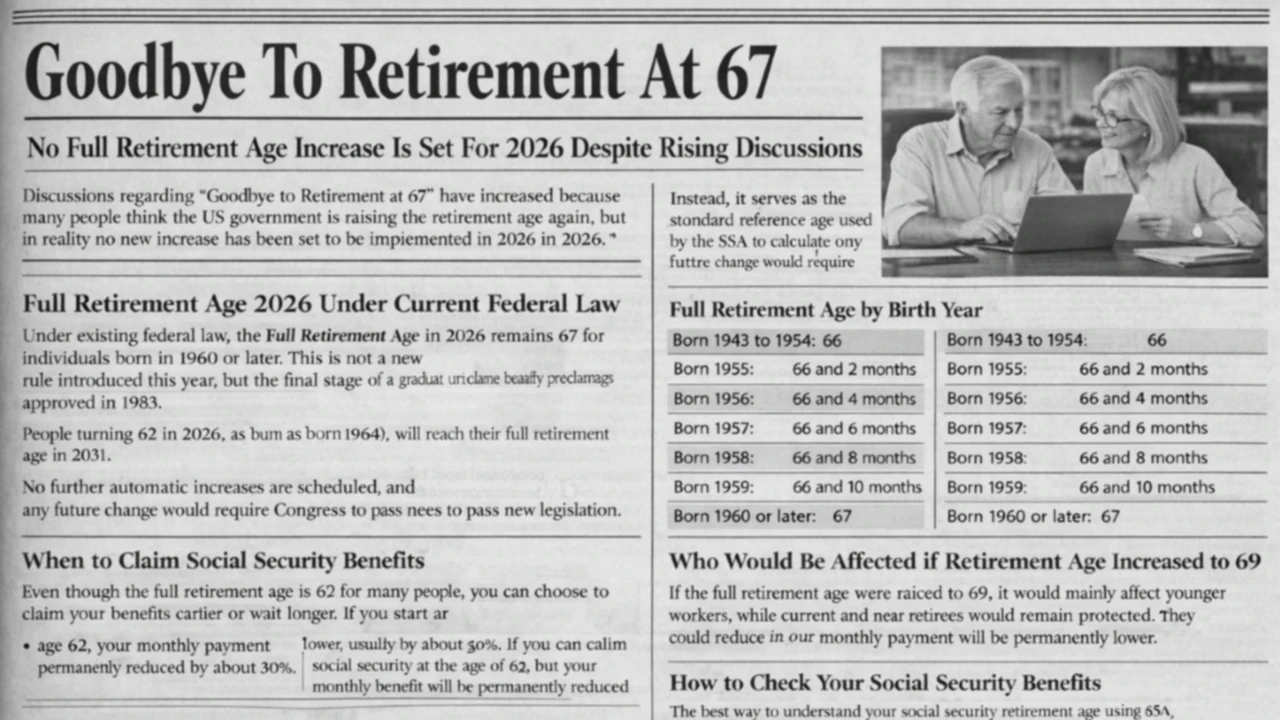
Recently, discussions about Goodbye to Retirement at 67 have increased because many people think the US government is raising the retirement age again, but in reality no new increase has been set to be implemented in 2026.
People are talking about FRA 2026 changes because this year simply marks the end of a plan that started many years ago. Through this article, we will discuss details related to Social Security FRA Changes 2026, including its Overview, FRA Under Current Law, its Impact, and FRA Chart by Birth Year.
Goodbye to Retirement at 67

Full retirement age is the age at which a person can claim their complete Social Security retirement benefit with no deductions or penalties. It does not mean you must retire, and it does not stop you from working.
Instead, it serves as the standard reference age used by the SSA to calculate reductions for early claims and increases for delayed claims.
Social Security FRA Changes 2026 Overview
| Authority | Social Security Administration |
| Program Name | Social Security Retirement Benefits |
| Program Type | Federal Social Insurance Program |
| Country | USA |
| FRA in 2026 | 67 years |
| Early Claiming Age | 62 years |
| Eligibility Requirement | Minimum 40 work credits |
| Type of Benefits | Retirement Income Benefits |
| Category | News |
| Official Website | https://www.ssa.gov/ |
FRA Under Current Federal Law
- Under existing federal law, the Full Retirement Age 2026 remains 67 for individuals born in 1960 or later.
- This is not a new rule introduced this year but the final stage of a gradual increase approved in 1983.
- People turning 62 in 2026, who were born in 1964, will reach their full retirement age in 2031.
- No further automatic increases are scheduled, and any future change would require Congress to pass new legislation.
Full Retirement Age by Birth Year
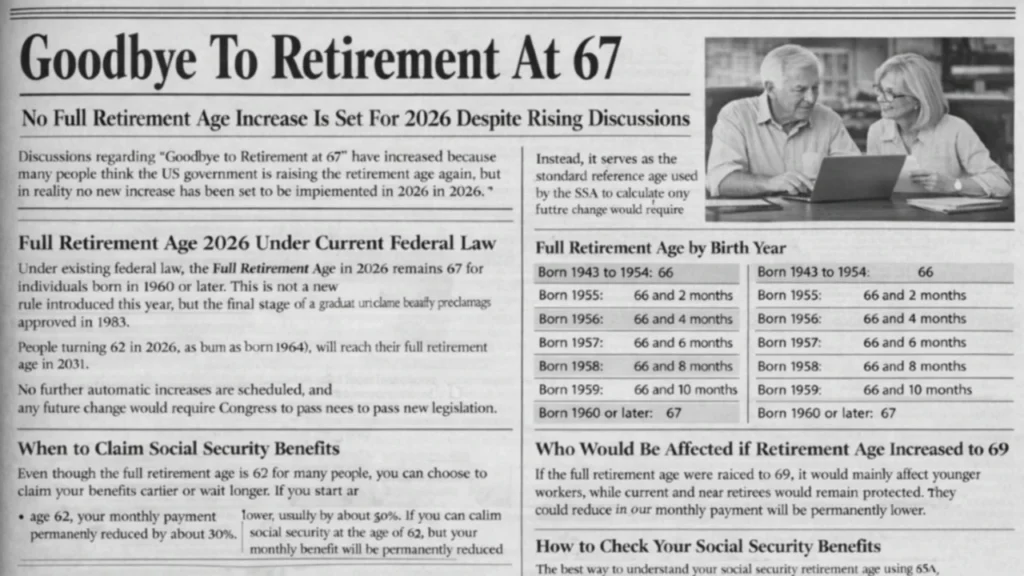
The Social Security Administration sets the full retirement age by birth year, and this chart shows that the increase is now complete and the age is fixed under current law.
| Year of Birth | Full Retirement Age |
|---|---|
| Born 1943–1954 | 66 years |
| Born 1955 | 66 years, 2 months |
| Born 1956 | 66 years, 4 months |
| Born 1957 | 66 years, 6 months |
| Born 1958 | 66 years, 8 months |
| Born 1959 | 66 years, 10 months |
| Born 1960 or later | 67 years |
When to Claim Social Security Benefits

Even though the full retirement age is 67 for many people, you can choose to claim your benefits earlier or wait longer. If you start at age 62, your monthly payment will be permanently lower, usually by about 30%.
If you choose to wait beyond your full retirement age to claim benefits, your monthly payment increases by roughly 8% for each year you delay, up to age 70, allowing you to receive a larger amount in the long term.
Who Would Be Affected if Retirement Age Increased to 69
- If the full retirement age were raised to 69, it would mainly affect younger workers, while current and near retirees would remain protected.
- They would have to wait longer to receive their full SSA benefits, which could reduce the total amount they receive over their lifetime.
- Experts suggest this change might lower average benefits by about 13%, with bigger reductions for those who choose to claim early.
- People who work in physically demanding jobs, have health concerns, or have a shorter life expectancy would feel the impact more severely.
How to Check Your Social Security Benefits
- The best way to understand your social security retirement age is through the official tools provided by SSA.
- These calculators and personal accounts are based on current law and ignore political proposals.
- They allow workers to view earnings history, estimate future payments, and test different claiming ages to find the most perfect strategy.
FAQs
Is the US government increasing the Full Retirement Age in 2026?
No, there is no new Full Retirement Age increase in 2026, the FRA remains 67 under current law.
Can I still claim Social Security at 62 in 2026?

Yes, you can claim social security at the age of 62, but your monthly benefit will be permanently reduced by about 30%.
Will Full Retirement Age happen automatically?
No, any Full Retirement Age increase would require new legislation passed by Congress.